
Consent isn’t just a word you say before an escort encounter-it’s the foundation of every safe, respectful, and stress-free interaction. Too often, people assume that because money changes hands, boundaries become fuzzy. That’s not true. In fact, the opposite is true: when money is involved, clear communication becomes even more critical. You’re not just selling a service-you’re managing trust, safety, and personal limits. And that starts long before the client walks through the door.
What Consent Really Means in Escort Work
Consent isn’t a one-time nod or a quick "yes" when someone asks if you’re okay with something. It’s ongoing, specific, and reversible. If a client says, "Can I touch your hair?" and you say yes, that doesn’t mean they can later move to your thighs without asking again. Consent is like a menu-you pick what you’re comfortable with, and you can change your mind at any point. No guilt. No pressure.
Many new escorts think they need to say yes to everything to keep clients happy. That’s a dangerous myth. Clients who respect boundaries will appreciate honesty. Those who don’t? They’re not worth your time or safety. The most successful escorts I’ve worked with in Brighton don’t just set boundaries-they state them clearly upfront, in writing, and reinforce them verbally before any physical contact.
Writing Clear Service Descriptions
Your profile on AdultWork or any platform is your first line of defense. Vague descriptions like "fun, friendly, and flexible" invite confusion. Instead, list exactly what you offer and what you don’t. Be specific.
Good example: "I offer massage, cuddling, and conversation. No sex, no kissing, no anal. No drugs on premises. All encounters require verbal confirmation before any touch beyond handshakes."
Bad example: "I’m open to anything as long as it’s safe."
"Safe" means nothing without context. Who defines it? You? The client? That’s a loophole waiting to be exploited. Write out your limits like a contract. Use bullet points. Make it easy to read. Clients who skim will still see "NO SEX" or "NO KISSING" in bold. Those who read carefully will feel reassured you know what you’re doing.
Pre-Encounter Communication Is Non-Negotiable
Never skip the pre-encounter chat. This isn’t small talk-it’s risk management. Ask the client three questions before they arrive:
- What are you hoping to get out of this visit?
- Have you been with an escort before? If so, what did you like or dislike?
- Do you have any health concerns or recent STI tests you’re willing to share?
These questions serve two purposes. First, they filter out people who aren’t clear about their intentions. Second, they give you control of the conversation. If a client answers with vague or pushy responses-"I just want to see what happens" or "You’ll know when you feel it"-that’s a red flag. Walk away. You don’t owe anyone your comfort.
Also, never agree to meet without a confirmed location, time, and ID verification. Use a trusted third-party service to verify a client’s identity if you’re unsure. Even something as simple as asking them to send a photo of their driver’s license (with the number blurred) can stop a lot of bad situations before they start.

Verbal Check-Ins During the Encounter
Even if you’ve set boundaries in writing, things can shift in the moment. A client might get turned on and forget the rules. Or they might misread your body language. That’s why you need to check in-out loud-during the encounter.
Try phrases like:
- "Is this still okay?"
- "Do you want to keep going like this?"
- "I’m good with this, but let me know if you want to change anything."
These aren’t awkward-they’re professional. They signal confidence, not insecurity. And if you feel uncomfortable at any point, say "stop" and mean it. No explanations needed. No apologies. Your safety comes first, always.
What to Do If Someone Crosses a Boundary
It happens. Even the clearest profiles and conversations don’t stop everyone. If someone ignores your limits, here’s what to do immediately:
- Stop the encounter. Get up. Put your clothes on. Walk to the door.
- Call a trusted friend or colleague and tell them your location and what happened.
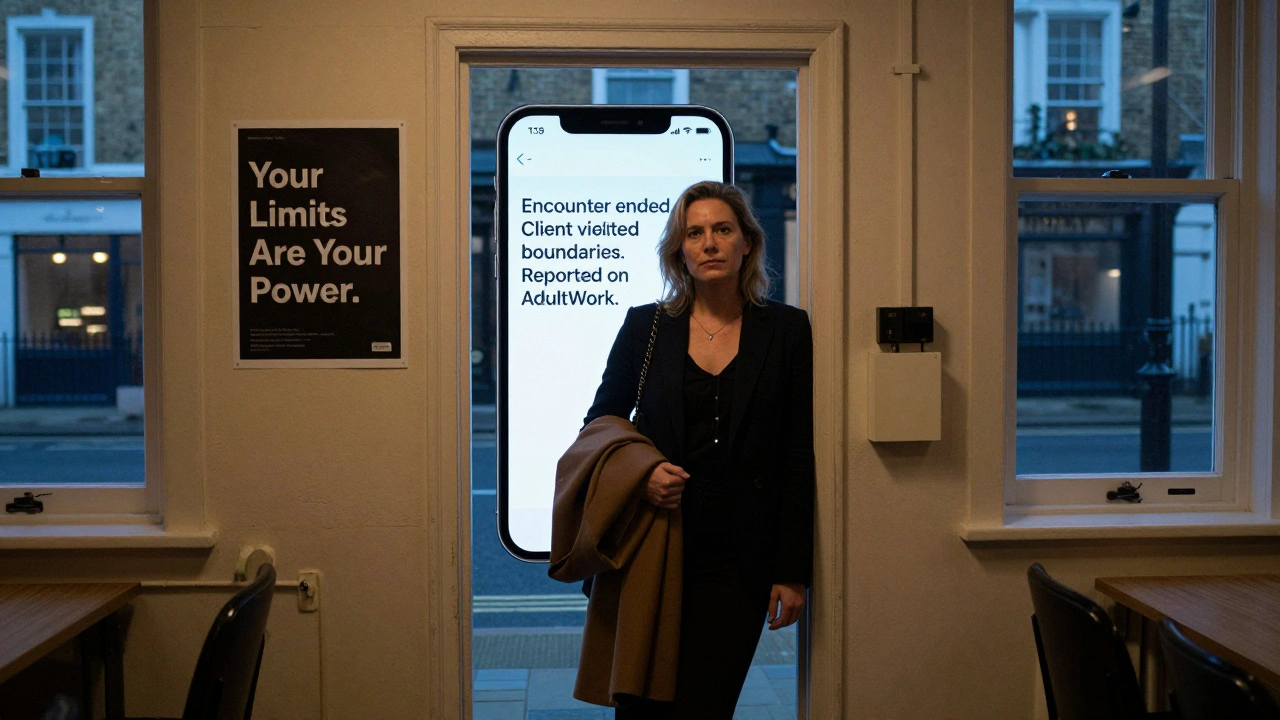
- Report the person on AdultWork and any other platform you use. Include the date, time, and exact words they used.
- Save all messages. Screenshots matter. If you need to involve police later, you’ll need proof.
Don’t worry about "ruining" their reputation. You’re not the one who broke the rules. The person who violated your consent is. Reporting them helps protect other workers. And if you feel unsafe, contact the UK-based sex worker safety line at 0800 019 9975. They offer confidential support, legal advice, and can help you file a report anonymously.
Why Clear Communication Builds Better Business
Some escorts think being vague keeps clients coming back. It doesn’t. It creates chaos. The most consistent, high-paying clients are the ones who know exactly what to expect. They appreciate structure. They respect boundaries. They return because they feel safe and treated like adults-not because you said yes to everything.
When you communicate clearly, you attract the right people. You reduce the number of no-shows, last-minute cancellations, and confrontations. You also reduce your own stress. You’re not guessing. You’re not second-guessing. You’re in control.
In Brighton, where I’ve worked for years, the most respected escorts aren’t the ones with the most photos or the flashiest profiles. They’re the ones who say exactly what they do and don’t do-and stick to it. Their clients come back because they know what they’re getting. And that’s worth more than any temporary extra.
Tools and Resources for Safer Work
You don’t have to do this alone. There are tools made specifically for sex workers to stay safe:
- Shields - A free app that lets you share your location with trusted contacts during appointments.
- Escort Safety UK - A volunteer-run network that offers peer support and safety check-ins.
- The UK Network of Sex Work Projects (UKNSWP) - Provides legal advice, health resources, and advocacy.
- AdultWork’s safety section - Includes templates for pre-encounter messages and how to report unsafe clients.
Use them. They exist because real people-workers like you-built them. You’re not being paranoid by using them. You’re being smart.
Final Thought: Your Boundaries Are Your Power
Consent isn’t about saying no. It’s about saying yes-on your terms. Every time you speak up, you reinforce your right to be safe, respected, and in charge. It’s not selfish. It’s survival. And it’s professional.
There’s no glory in pushing through discomfort. There’s no bonus for being "easy." The best version of your work is the one where you feel calm, in control, and proud of how you show up. That starts with clear communication. And it ends with you knowing-without a doubt-that your limits matter.
Is consent still required if a client pays upfront?
Yes. Payment doesn’t override personal boundaries. Consent must be given freely, repeatedly, and can be withdrawn at any time-even after money has been exchanged. A client who thinks payment equals unlimited access is not a safe or respectful client.
How do I say no without losing a client?
You don’t have to keep every client. The right clients will respect your limits. If someone leaves because you said no to something you’re not comfortable with, that’s not a loss-it’s a filter. You’ll find more reliable, repeat clients who appreciate honesty over false flexibility.
What if I feel pressured to say yes during an encounter?
Trust that feeling. Pressure-even subtle-is a warning sign. You have the right to stop at any moment. Say "I’m not comfortable with this," then get up and leave. Your safety is more important than any payment. Call a friend or safety line immediately after.
Can I change my service list after setting it?
Absolutely. Your boundaries can evolve. Update your profile whenever you need to. Let your clients know in advance if you’re changing what you offer. Most will understand. Those who don’t? You’re better off without them.
Do I need to share my STI status with clients?
You’re not legally required to, but it’s a smart professional practice. Many clients ask. If you’re regularly tested and negative, sharing that builds trust. If you’re not, say so clearly: "I don’t share STI status, but I only offer services that don’t involve bodily fluid exchange." Honesty reduces risk for everyone.